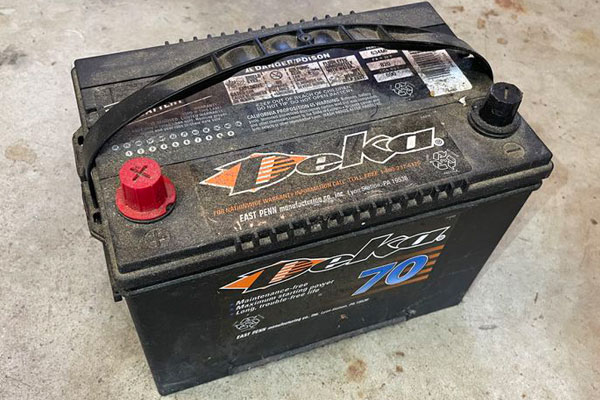
Knowing how to safely store unused car batteries will prevent them from deteriorating or becoming completely unusable. Follow the following car battery maintenance tips at Proautoenthusiast.com
The secret to keeping a vehicle in good condition is regular maintenance. However, it is possible that we are faced with the need to leave the car stopped for a considerable time, whether it is for a work trip, a family trip or for another reason. When we return home, we will find that the car does not start. It’s no secret that the first component to suffer from prolonged downtime is the car’s battery.
Normally, car batteries can last up to 4 years ; however, having the vehicle stopped or idle for a long time will accelerate its deterioration and shorten its useful life significantly. There are a few tricks to mitigate wear and tear, such as putting the vehicle to work for a short time on certain days. However, sometimes this is impossible because there is no one to start it while we are away.
If we are faced with this situation, Proautoenthusiast recommends that you disconnect the car’s battery . Some choose to leave it in its original place, however, keeping it in favorable conditions is even more effective. While wear and tear and power loss cannot be avoided, it will happen more slowly if we follow the following car battery maintenance tips.
First of all, we must understand that car batteries naturally discharge when stored. When its level drops below 100% charge, a process known as sulfation begins. This means that sulfate crystals form in the pores, invading the plates within the component.
The worst case scenario occurs when the battery is dead and continues to be in storage. Because the electrolyte is below its proper level, the lead sulfation re-crystallizes to hard lead sulfate. Once this occurs, there is no turning back, as he cannot transform back even with a recharge process. It is worth mentioning that the deterioration is accelerated if it is located in very hot places.
1. Cleanup and damage search
Once we disconnect the battery from the car, we have to carry out a thorough check to find any possible damage. This is an external exploration to find damage to the box. If we see corrosion , it is important to remove it before storing it, in addition to that we will also have to clean the contact posts.
2. Put the electrolyte to the level
The sulfation process will start when the electrolyte is not at its correct level. Therefore, we will review its status before storing it. If necessary, we will add water to the small tank to slow down the discharge. eye! We will only have to make sure to leave it at the level, since exceeding ourselves is also counterproductive.
3. Recharge before storage
If our battery was connected in a car that has not been used for a few days, there is a possibility that it is slightly discharged. Once we disconnect it, we will proceed to put it on top and equalize it. This last process refers to a controlled overload, which is necessary to prevent sulfation problems and to give you a more stable performance.
When performing a car battery equalization, the sulfate crystal on the plates breaks. In this way, said substance is mixed again with the sulfuric acid. It is a technique that allows all areas of the battery to work with the same level of charge, improving performance and extending its durability.
To carry out the equalization of the battery, it should be done with a special high-quality charger that gives us the automatic option. Some experts recommend equalizing it once a month, while others suggest doing it once every 6 months.
4. The best storage place
If we have already done all of the above, let’s not make the mistake of storing car batteries in a room without the right conditions. Nor should it be left under the chest, but instead find a cool, dry place. Although it is true that a cold climate will delay the sulfation process, it is also not good to overdo it and leave it in rooms exposed to winter temperatures.
If money is not an issue, we could buy a regulated voltage charger compatible with our battery, in order to perform a float charge. Some devices take charge of charging to the maximum level when they detect the slightest drop in voltage. Before purchasing one of these devices, we must verify that we can use them with our battery, since the result could be disastrous.