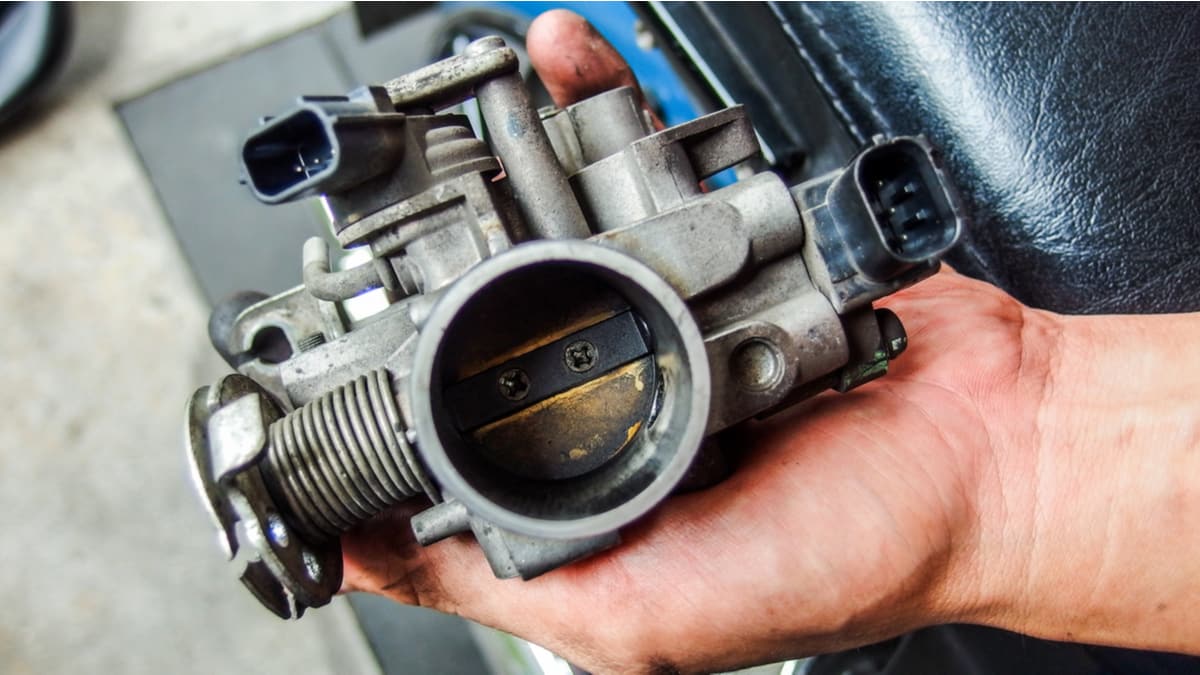
Among the most notorious mechanical components of cars is the throttle body. At Proautoenthusiast we explain what this part is, its relevance, and what its faults are.
Talking about mechanical components of our car always involves certain complications, and it is that many times names of auto parts with which we are not familiar come up. One of these parts is the throttle body. At Proautoenthusiastm.com we explain everything about this part in the simplest way possible.
In this article, in addition to explaining what the car’s throttle body is, we will tell you what its most common failures are, as well as its role in the engine’s operation, and the symptoms that reveal that something is wrong with it.
1. What is the throttle body?
The throttle body of your car, if it were a mammal, would be the lung. This device is responsible for managing the entry of air into the intake manifold. The throttle body uses a regulating mechanism or valve, commonly known as a butterfly, which opens and closes to a greater or lesser extent as we press the accelerator pedal.
The throttle body fulfills the mission of delivering the precise amount of air for the correct engine combustion process. The amount of air supplied by the throttle body to the intake manifold is the one that mixes with the gasoline to subsequently be ignited by the electric arc generated by each spark plug.
A key component of the throttle body is the valve mentioned above. The butterfly is a metal sheet that is crossed from side to side by an axis, typically known as a butterfly axis. The butterfly is located at the entrance of a cylinder that we commonly call the throttle body, but it is only a part of it.
The accelerator pedal controls the rotation of the throttle shaft, and as a consequence, the rotation of the throttle, which in turn is the only and irreplaceable regulator of the air intake to the intake manifold. So: the higher the pressure on the accelerator pedal, the greater the opening allowed by the butterfly, and the greater the flow of air to the intake manifold.
Speaking of butterfly valves, there are two types: the first one is assembled inside a tubular orifice, and works similarly to beer keg valves. The second of them, and more common, is the one that is connected to the accelerator by means of a plate and a whip or an electronic controller, it is activated outside the throttle body.
The IAC valve is also part of the throttle body. This component is responsible for regulating the opening of the throttle valve when you are not pressing the accelerator, for example, when you put the lever in neutral, or when you press the clutch to change gear.
2. Throttle Body Symptoms and Faults
Throttle body faults are easy to diagnose and are generally inexpensive to repair. Most of them have to do with dirt build-up in the throttle area or IAC valve failure .
One of the most common symptoms of a throttle body failure is delayed accelerator pedal action. If you have noticed that you press the accelerator and there is a delay of one or two seconds in the response, and also when you release it there is also a delay, there could be a accumulation of dirt in the throttle valve, which causes its mobility to be reduced. be reduced, and should be cleaned.
Another of the symptoms of faults in the throttle body is a noticeable tendency to accelerate more than it should in any circumstance, but especially at idle, that is, when you have no gear engaged and the engine runs on its own. In this case it could be dirt accumulated in the IAC valve or specifically a fracture in this component.
The last of the common throttle body faults is a noticeable rise in revs both while accelerating and idling. In this case, this fault may be due to some perforation in the throttle body cylinder, either due to corrosion or knocks.
3. The relevance of the throttle body and its maintenance
As you may have already noticed, this component plays a key role in engine speed stability and performance. As it is in charge of the air intake to the intake manifold, any mismatch, damage or imbalance in the amount of air supplied will be immediately noticed in the car’s acceleration response.
The proper functioning of the engine depends a lot on the throttle body
The throttle body is an extremely important part of your car’s ride quality, since the uniformity of acceleration and deceleration depends on its good condition. It is advisable to periodically maintain it together with the scheduled services of the car, cleaning the throttle valve and inside the cylinder.
WHAT ARE THE SYMPTOMS OF A DIRTY THROTTLE BODY?
HOW DO YOU CLEAN THE THROTTLE BODY WHEN IT IS REMOVED FROM THE CAR?
Disassembling this component allows it to be cleaned as thoroughly as possible. However, it will take longer to do so.
- From the list above, repeat steps 1, 2, 3, 4 and 5. Note that you may need more tools as you will have to disassemble the entire assembly. In addition, it is recommended to prepare a clean container to be able to drain the coolant and also have fresh coolant, identical to the one that is being used at that moment.
- Remove the air cleaner housing if necessary to access the throttle body.
- Loosen all clamps, then disconnect all electrical connectors, hoses, and lines from the throttle body. Take extra care when removing the hose from the cooling system, especially if the engine has been running just before: the coolant may still be hot.
- Release the throttle body fasteners and remove it from the car. On some vehicles, you can find an additional fastening, a bracket. If it is a mechanically actuated throttle, you will need to disconnect the throttle cable.
- Cover the intake manifold opening to prevent dirt from entering the unit.
- Disconnect the idle air control valve from the throttle body. You also have to clean it well.
- Apply some cleaner to the surface of your car’s throttle body and treat all those hard-to-reach cavities with it. Remove all contaminants using a brush and soft cloth or paper towels.
- Dry items that have been cleaned.
- Clean the throttle body mounting seat and install a new gasket.
- Reinstall all the components in place by following the reverse order of steps.
- Check the coolant level. Fill it in if necessary.
- Reset component. Read on to find out how it’s done.
RESETTING A THROTTLE WITH MECHANICAL CONTROL
- Remove the battery terminals for 15 minutes. Then connect them again. If you have already disconnected them while cleaning the drive, you can skip this step.
- Start the engine. Let it idle for 10 minutes. Remember not to switch on any additional consumers.
- Stop the engine for about 10 seconds. Start it again.
- Wait until the engine warms up and reaches its operating temperature. After that, you can start using the vehicle.
- Please note: you may have to drive 150-200 km until the idle stabilizes.
RESETTING AN ELECTRONICALLY CONTROLLED THROTTLE
The reset process may vary between different vehicles. Therefore, before starting the procedure, you should refer to the vehicle manual for the exact sequence of steps. The general procedure is as follows:
- Study the procedure and try to remember it. You’ll need to act quickly, so you won’t have time to go over the details.
- Start the engine. Wait for it to warm up to operating temperature.
- Stop it for 10 seconds.
- Switch on the ignition for 3 seconds.
- Step on the accelerator pedal quickly 5 times. Each press should take one second.
- Depress the accelerator pedal fully for 7 seconds. Hold it down until the “Check Engine” light comes on and hold it for 3 more seconds.
- Release the accelerator pedal and start the engine.
HOW TO PREVENT THE THROTTLE BODY FROM GETTING DIRTY?
- YoUse only high quality fuel . Otherwise, impurities and contaminants will be drawn into the engine, causing the rapid formation of carbon deposits on the throttle body. For the same reason, you should not overlook the replacement of the fuel filter. It is advisable to bleed the fuel tank from time to time.
- YoReplace the air filter in good time . You should always make sure that the intake system remains airtight. This simple check prevents unfiltered air from being sucked into the intake system where its components are not firmly connected.
- YoAlso make sure that the crankcase ventilation system is not faulty . If it fails, this results in the rapid formation of oil deposits on the throttle body.
conclusion
The stability and performance of the engine depend on the proper functioning of the related assemblies. Therefore, cleaning the throttle body is one of the mandatory maintenance procedures for the intake system. Our tips will help you to do it yourself and save expenses on services from the mechanical workshop.